
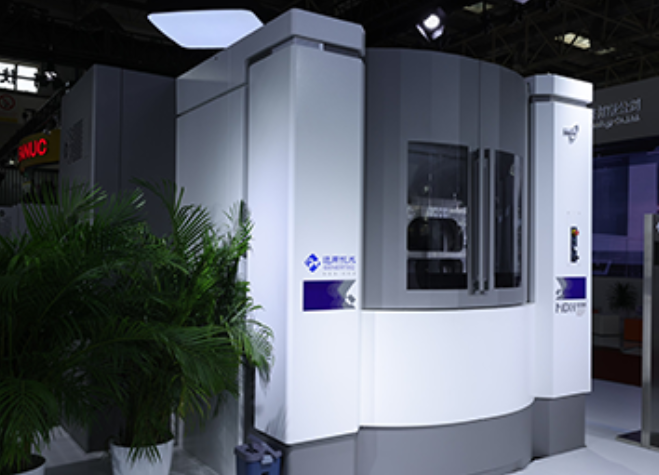
Description
I. Application Areas
The HDL series inline three-axis horizontal machining center is an independently developed series of machining centers. This machine tool can be widely used for machining plate, disc, box, shell, and precision parts. After a part is clamped once, multiple processes such as milling, boring, drilling, reaming, tapping, etc., can be completed. It is suitable for multi-variety, small-batch processing of parts with concentrated processes, and is also suitable for forming flexible automated machining lines to complete the mass production of engine blocks and cylinder heads in the automotive industry.
II. Machine Tool Features
1. Structurally, it adopts a three-axis design with a linear tool magazine located on top of the machine tool. This reduces the width of the machine tool, making the structure more regular and compact, and effectively realizing serial and parallel line connections. This improves factory floor space utilization and saves costs for users.
2. The online manual tool changer allows tool exchange tasks to be completed without affecting machine operation, improving the automation level of the machine tool.
3. In terms of logistics, the machine tool’s simple and compact layout allows for various workpiece loading and unloading methods, including gantry robots, machine tool bypass, and front-end direct-access, facilitating production line layout.
III. Key Technical Indicators
1. The spindle bearings utilize oil-air lubrication technology, extending bearing life and improving the reliability of high-speed spindle operation.
2. Advanced spindle temperature compensation technology is applied to achieve dynamic compensation for machine tool thermal errors, improving machining accuracy.
3. High-speed spindle circulating water cooling technology is applied, effectively reducing heat generation in the spindle stator and front-end bearings, ensuring spindle rotational runout accuracy, and meeting workpiece machining accuracy requirements.
4. High-speed electric spindle dynamic balancing experiments are conducted to ensure reliable spindle operation at high speeds, enabling the machine tool to achieve high-speed cutting.
5. The machine tool employs thermal deformation compensation technology to offset errors caused by thermal deformation of the lead screw during high-speed operation;
6. The machine tool’s rapid traverse speed of 54 m/min shortens processing time and improves processing efficiency;
7. The machine bed is a single casting, and finite element analysis was used during the design process to make the structure more rational.

Reviews
There are no reviews yet.