
Hot-dip galvanizing: Long lasting protection for steel products
Hot-dip galvanizing: Long lasting protection for steel products
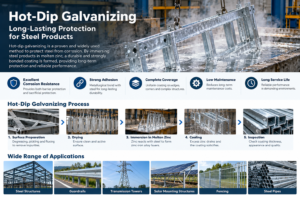
Corrosion is one of the major factors affecting the service life, safety, and maintenance cost of steel products. In outdoor, humid, coastal, and industrial environments, steel is continuously exposed to moisture, oxygen, and corrosive substances, making effective surface protection especially important.
As one of the most widely used corrosion protection methods, hot-dip galvanizing offers excellent durability, strong coating adhesion, and reliable long-term performance. It is widely used in construction, transportation, power transmission, energy, agriculture, warehousing, and infrastructure projects.
Hot-dip galvanizing is a process in which properly cleaned and prepared steel products are immersed in molten zinc. During this process, zinc reacts metallurgically with the steel surface to form a series of zinc-iron alloy layers together with an outer zinc layer. Unlike simple surface coatings, the galvanized coating becomes strongly bonded to the steel substrate, providing durable protection against corrosion.
Excellent Corrosion Resistance
One of the greatest advantages of hot-dip galvanizing is its outstanding corrosion resistance. The zinc coating acts as a physical barrier, preventing moisture, oxygen, and other corrosive elements from directly contacting the steel surface.
In addition, zinc provides cathodic protection. Even if the coating is locally scratched or slightly damaged, the surrounding zinc can continue to protect the exposed steel through sacrificial action, helping slow down the spread of corrosion.
Strong Adhesion and Mechanical Durability
During hot-dip galvanizing, the zinc coating forms a metallurgical bond with the steel substrate. This creates a durable coating with excellent adhesion and good resistance to impact, abrasion, and handling damage.
Compared with many conventional paint systems, galvanized coatings are less likely to peel or flake during transportation, installation, and long-term use.
Comprehensive Surface Coverage
Because the steel product is completely immersed in molten zinc, hot-dip galvanizing can provide protection to edges, corners, recesses, and other areas that may be difficult to cover evenly by spraying or painting.
For suitably designed hollow or complex components, internal and external surfaces can also be galvanized, providing more complete corrosion protection.
Low Maintenance and Long-Term Cost Efficiency
The true cost of corrosion protection is not limited to the initial coating expense. It also includes inspection, surface preparation, repainting, repair, labor, equipment, and possible production downtime.
Hot-dip galvanized steel generally requires relatively little maintenance during its service life. For structures installed in difficult-to-access locations, such as transmission towers, bridges, road barriers, solar mounting systems, and industrial facilities, reduced maintenance requirements can provide significant long-term economic benefits.
Stable and Mature Production Process
Hot-dip galvanizing is a well-established industrial process that normally includes degreasing, pickling, fluxing, drying, immersion in molten zinc, cooling, and inspection.
By carefully controlling steel chemistry, surface preparation, zinc bath temperature, immersion time, and other production parameters, manufacturers can achieve consistent coating thickness, appearance, adhesion, and corrosion resistance.
Products can also be manufactured and inspected according to applicable international or customer-specific standards.
Wide Range of Applications
Hot-dip galvanized products are widely used in:
- Steel structures
- Guardrails and fencing
- Transmission towers
- Solar mounting structures
- Communication infrastructure
- Agricultural equipment
- Scaffolding
- Warehouse systems
- Steel pipes
- Wire products
- Fasteners
- Various fabricated steel components
For products used outdoors or in demanding environments, hot-dip galvanizing provides an effective combination of corrosion resistance, mechanical durability, long service life, and reduced maintenance requirements.
As global customers place increasing emphasis on product durability and lifecycle cost, hot-dip galvanizing continues to be one of the most reliable and economical solutions for protecting steel products.
With proper material selection, production control, and quality inspection, hot-dip galvanizing can significantly improve the long-term reliability and service performance of steel products across a wide range of industries.